Why Do We Even Read the Old Testemant Anymore
The Old Attestation has always been an easy target for critics of Christianity. On the surface, its harsh moral codes and ancient cultural norms come across today as obsolete at best, barbarian at worst. While this is hardly new, it has led recently to louder calls to downplay its significance, such equally when prominent pastor Andy Stanley suggested in 2018 that Christians should "unhitch" the Quondam Testament from their theology. Only many Bible experts disagree. This is the first in a six-part series of essays from a cross-section of leading scholars revisiting the place of the "Showtime Testament" in gimmicky Christian faith.
—The Editors
Already in the 2d century, the arch-heretic Marcion pressed this question and came to the conclusion that the Old Testament offered most nothing to Christianity. He was excommunicated for his views. In the 20th century, the Nazis enacted a remarkably successful elimination of the Old Testament from Christian organized religion and countless "German Christians" followed suit—to horrific ends. In more recent days, preachers from micro-congregations to multi-campus megachurches struggle with what to do with the Old Attestation. Many do their best, many less than that. Some see no way frontwards simply to "unhitch" the ii testaments of the Christian Bible.
All of this difficulty with the Old Testament is unfortunate considering every page of the New Testament depends on it—extensively, almost exclusively. The very first poesy of Matthew is a case in betoken: "The book of the genealogy of Jesus Christ, the son of David, the son of Abraham" (ESV). Without the Old Attestation, readers have no inkling what "Christ" means, who David and Abraham are, or how all these figures are related. The original text is fifty-fifty more suggestive: "The book of the genealogy" is biblos geneses in Greek—a rather obvious innuendo back to the Book of Genesis.
But the New Testament's dependence on the Sometime goes beyond mere data—in some passages, the New Testament suggests that the Old Testament is fully sufficient all past itself for a saving knowledge of God. Consider Jesus' parable nearly the rich man and Lazarus (Luke xvi:19-31), where Abraham informs the rich human that no one will be sent back from the dead to warn his wayward brothers because, "If they do not listen to Moses and the Prophets, they will not be convinced even if someone rises from the expressionless" (five. 31).
Texts like Matthew 1 or Luke sixteen are everywhere in the New Testament and no doubt give rise to well-significant statements like: "You can't understand the New Testament without the Old Testament," or, per the adage from St. Augustine: "In the Old Testament the New lies concealed, in the New Testament the Old is revealed." There is nothing wrong with such truisms, but they seem by and large ineffective in completely solving the problem because, in betoken of fact, many Christians continue to wonder well-nigh the Erstwhile Testament in a way that they just don't (and never will) about the New Testament. And then the question remains: "What does the Old Testament offering to Christianity today?"
My own answer is: Much. Maybe everything.
There are at least four significant gifts the Erstwhile Attestation offers to Christian organized religion. If these gifts are not unique to the One-time Attestation, they are nevertheless far more nowadays in the Old than in the New, and then constitute precious aspects of the whole counsel of God.
Honesty
The Old Testament is candid, fifty-fifty brutally so. The oft absorbing, occasionally off-putting candor of the Onetime Testament often offends modern sensibilities. Think, for case, of the savage sentiments nigh enemies constitute in various psalms, even in a much honey ane similar Psalm 139. That is my female parent-in-law'due south favorite psalm (except for verses xix-22). But this honesty is a gift, not cause for warning. If nosotros ourselves are aboveboard, nosotros must admit nosotros have occasionally thought or wished similar things on our own enemies—and not always in prayer! Throughout the ages, it has been the barbarous honesty of the psalms, especially in hard times, that has led to their popularity.
But information technology is not merely the psalms; the whole Old Testament is honest in a manner that, to exist frank, many Christians simply are non. Stories of State of israel'south disobedience and sin come to mind at this bespeak. These are often grist for homiletical moralizing, fifty-fifty Christian disparagement of the Onetime Testament (and biblical Israel). Simply nosotros must call up that these accounts are but preserved in the Old Testament because of its candor. Christians only know these stories because Israel was honest enough to relay them. Honesty about sin and suffering are two of the many ways the Former Testament sets usa an example of being honest earlier God and the world and being honest about God and the world. Israel's history is no more full of failure than the church building'southward, which is as well pockmarked with failings of the most egregious sort. State of israel'south history is total of honesty. That is a gift to be emulated.
Poetry
Information technology is non surprising that a book every bit honest equally the Old Testament abounds in poetry since, as Garrison Keillor puts it, good poems matter because they "offering a truer business relationship than what we're used to getting." Fully a third, peradventure more, of the Former Testament is poetic in grade. Contrast this with the New Testament, which offers united states of america precious little poetry. Moreover, the little that is found at that place—peculiarly in Revelation—is typically steeped in the language and symbolism of the Old Attestation.
The Old Attestation'south poetry lives especially in the psalms, but also in the prophets who sought (to quote Marker Twain) the "right give-and-take" as opposed to the "almost right word," since that is the departure betwixt lightning and the lightning bug. If the psalms offer the poesy of praise and pain in prayer, the prophets offer us poetry that is the very "Word of the Lord."
As the pelting and the snow
come up down from heaven,
and do not return to it
without watering the earth
and making information technology bud and flourish,
so that it yields seed for the sower
and breadstuff for the eater,
so is my word that goes out
from my mouth:
Information technology will non return to me empty,
only will accomplish what I want
and reach the purpose for
which I sent information technology. (Isa. 55:10-11)
Poetry is a key feature in other books besides, where information technology becomes an ideal medium for discussing wisdom for life (Proverbs), suffering (Chore), expiry (Ecclesiastes)—even love and sex (Song of Songs). But the topics are not limited to these; neither are the books. Wherever it is found, poetry seems preferred whenever the field of study matter is tricky—and what could be more than difficult to talk over than God and God'south ways in the earth?
Speaking of the daring imagery of the Old Testament, Walter Brueggemann wrote that "no piece of cake linguistic communication will always get this God said right." Poetry is not like shooting fish in a barrel language, and then is far better when speaking of the infinite God than flat prose—certainly superior to straightforward proposition. Poetry alludes fifty-fifty as it eludes; it evokes and reveals even as it obscures and remains reticent. In its reticence and in its revealing, poesy communicates and protects the holiness of God, the Lord of—and the Lord above—all language. Christians learn from the Old Testament's poetic penchant a deep respect for the mystery of God, who should never be spoken of lightly.
Theology
The third gift—closely related to the second—is theology, narrowly defined in this example as speech well-nigh God. A quick concordance search of "God" in the Mutual English Bible gives 1,109 hits in the New Testament, but 3,189 in the Old Testament. Those statistics are hardly surprising. The 39 books of the Old Attestation comprise 78 percent of the Protestant Christian Bible (even more in Cosmic, Orthodox, and Anglican canons). Merely there is more than going on in this third gift than simply the length of the Erstwhile Testament relative to the New.
The Old Testament has long been considered a primary repository for the doctrine of God—more than specifically, of the starting time member of the Trinity. Hither is where 1 learns start, foremost, and nearly extensively of the Ane whom Jesus called "Male parent." In light of the incarnation recounted in the Gospels and the giving of the Spirit in Acts, the One-time Testament is the place that affords special insight on "God the Father Omnipotent," though Christians are quick to confess that these Iii are One. Only divine oneness is missed whenever Christians side with Marcion in pitting "the Former Testament God" confronting Jesus in the New.
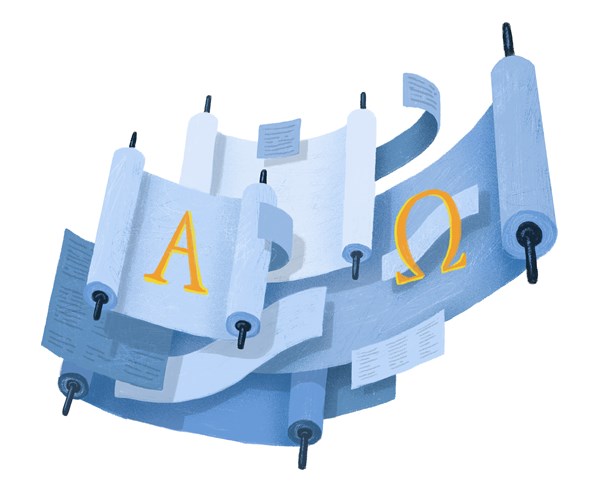
Image: Illustration by Matt Chinworth
Such sentiments reveal every bit much ignorance most the New Attestation as they do about the Onetime, especially since this distinction is typically fatigued with reference to the wrath and judgment of God. These topics grow in the New Testament equally much equally the Old, and not but in Revelation. They are common in Jesus' preaching, every bit his precursor John the Baptist saw then clearly (Matt 3:7-12). And then on this matter too, no less than others, Jesus and the Father are one (John 17:22).
This unity of the Testaments—and among the members of the Trinity—demonstrates that God indeed "displays his wrath every mean solar day" (Ps. vii:11b). But information technology also explains what such wrath is for: It is in service to justice, since "God is a righteous estimate" (Ps. 7:11a). Despite the divine standard of justice, God takes no pleasure in the death of the wicked only wants all to modify their ways and live (see Jer. 18:seven-8; Ezek. xviii:32; Jonah 3:10). Throughout the Bible—Old Testament and New—God'south judgment has an object: sin and injustice. When those are set right, wrath disappears.
The People of God
The One-time Attestation teaches Christians something crucial about ecclesiology—about beingness the people of God. One such thing would exist to love righteous deeds exactly like the righteous Lord (Ps. 11:7). Merely that is merely the tip of the iceberg. The listing of what the Old Testament teaches about what God's people must do and who they must be would take many pages. The point at hand is non the details of all that but the simple fact of all that.
The New Testament, of course, does much the aforementioned thing. The term "ecclesiology" derives from Greek ekklesia, used in the New Testament for the church (e.g., Matt. 16:xviii). But ekklesia too appears in the Greek translation of the One-time Testament, where information technology reflects the Hebrew word qhl ("assembly"), a term that conveys much the same idea: the community of faith. Be that as it may, this quaternary souvenir concerns the nature of Israel equally a grouping: a family, then a people, and then a nation with land—ane that stands together in covenant with God (Ex. 19:8), united in prayer and praise, rewarded and, aye, sometimes even punished as a grouping. The New Testament, too, reflects corporate understandings, sometimes in ways that are shocking (see, e.k., Acts 5:i-11).
Nevertheless information technology is quite common, especially in the individualized, industrialized West, to read the New Attestation as mostly a privatized thing—"Jesus and me"—and to go out politics and social justice out of it. The Male monarch who judges among the sheep and goats in Matthew 25:31-46 knows improve, and the severity and the criteria he uses to make his determination there sounds exactly like the Lord who legislates care for immigrants, widows, and orphans in Exodus 22:21-24—all the same another example of the unity of the Testaments.
This quaternary gift of the Erstwhile Testament teaches Christians that the life of faith is rarely—peradventure never—a affair of lonely, personalized piety. Information technology is, instead and at root, a communal matter, extending beyond matters of the heart solitary. To exist sure, the Lord's words must be inscribed on the heart in Deuteronomy 6, but information technology doesn't end there—the external trunk must likewise bear the Lord's educational activity, where it is in constant view on hands and brow, and and then written on houses, on the city, and even on the body politic (Deut. vi:6-9).
The Marks of the Old Attestation
To conclude: "We can't empathise the New Testament without the Old" is true equally far as it goes, but it doesn't become nearly far enough, since the One-time Attestation is, all by itself, indispensable for Christian organized religion. Augustine's famous argument, likewise, while accurate, is also insufficient. Much in the Old Testament is revealed—all of it, in fact, co-ordinate to Christian theology, non to mention the testimony of 2 Timothy 3:16 (where "Scripture" refers to the
Old Attestation).
Every bit that verse and the side by side become on to specify, the Old Attestation is eminently useful —"for education, rebuking, correcting and training in righteousness, and then that the servant of God may be thoroughly equipped for every skillful work" (2 Tim. three:sixteen-17). This is truthful considering "everything that was written in the past was written to teach united states, and then that through the endurance taught in the Scriptures and the encouragement they provide we might take hope" (Rom. 15:four).
Imagine a Christianity marked not by cover-up and denial just by honesty; a Christianity that spoke of God humbly and artfully—poetically—because the divine mystery dwells beyond all linguistic communication; a Christianity attuned to the theology of the Three-in-1, one in mercy and judgment so every bit to gratis the earth of sin and injustice; a Christianity unified as the corporate people of God, ransomed "from every tribe and language and people and nation" (Rev. v:9). That would be a Christianity adorned with the gifts the Former Testament provides.
Brent A. Strawn is professor of Former Testament at Duke Divinity School. He is the author of The Old Testament Is Dying: A Diagnosis and Recommended Treatment.
Take something to add together about this? See something we missed? Share your feedback here.
Source: https://www.christianitytoday.com/ct/2020/january-february/old-first-testament-bible-jesus-read.html
0 Response to "Why Do We Even Read the Old Testemant Anymore"
Post a Comment